
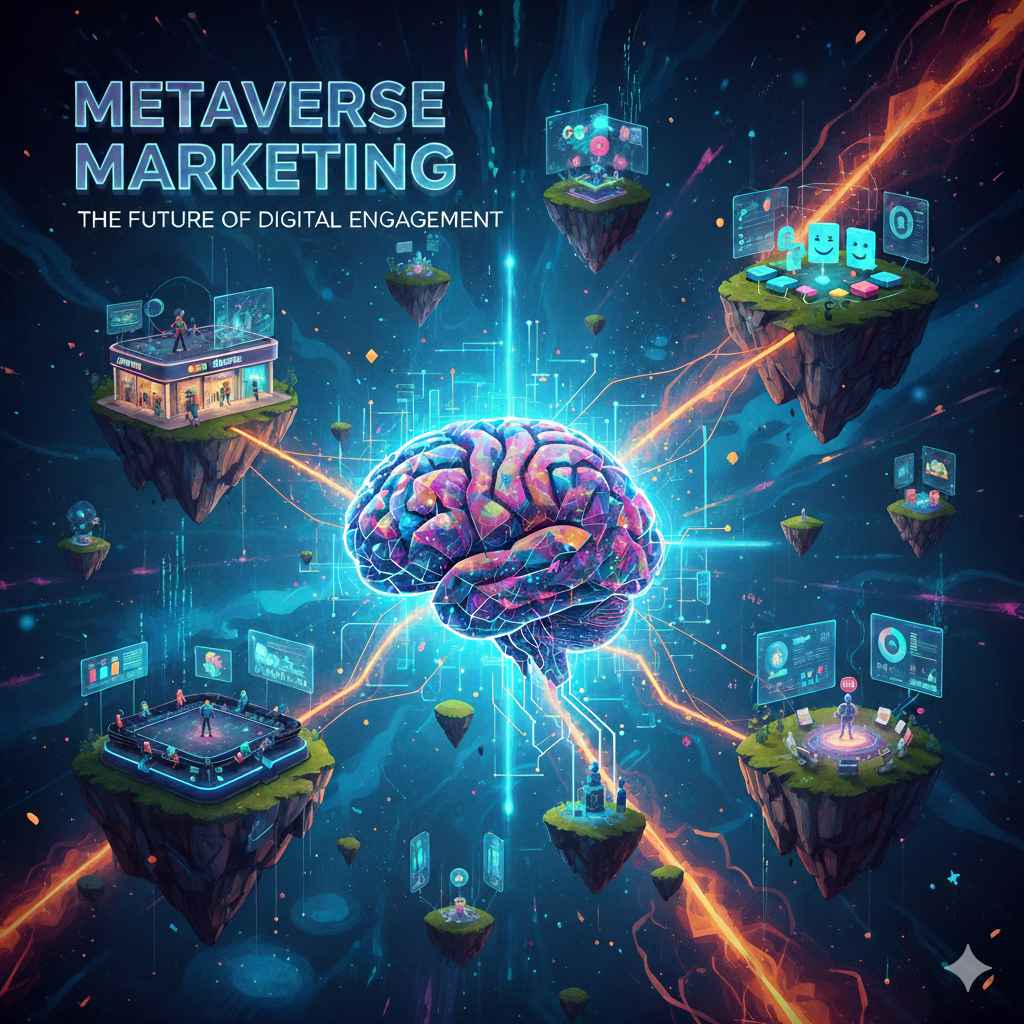
Introduction: The Rise of the Metaverse
The online space is changing more rapidly than ever before. From social media to virtual reality, technology keeps changing the way brands engage with people. Step in the Metaverse — a digital, immersive world where individuals connect, play, work, and even buy things with digital avatars.
Metaverse marketing is the next great frontier for brands wanting to remain at the forefront. It combines virtual reality (VR), augmented reality (AR), blockchain, and AI-powered experiences to deliver distinctive, engaging brand experiences.
In this post, we’ll explore what metaverse marketing is, why it matters, and how brands can harness its potential in 2025 and beyond.
What Is Metaverse Marketing?
Metaverse marketing is essentially the use of virtual environments to market products, services, or brands — these environments are typically 3D, interactive, and decentralized. While traditional online marketing is still an option and can be done on flat screens, metaverse marketing is a step further as it is performed in immersive digital worlds such as:
- Meta Horizon Worlds
- Roblox
- Decentraland
- The Sandbox
- Fortnite Creative Spaces
As a result, users in the metaverse have a chance to visit virtual events, sample digital products, or engage with a brand through immersive experiences — hence, a totally new dimension of customer engagement has been created.
Why Metaverse Marketing Matters
1. Immersive Brand Experience
Brands in metaverse are not just confined to ads or posts — they have the power to build whole experiences.What if you could stroll through a virtual Nike store, personalizing your sneakers, or be a part of a Gucci fashion show in Decentraland?
2. Deeper Audience Engagement
Traditional ads are interruptions.The metaverse marketing is about giving the users the freedom to engage, discover, and even come up with content. The loyalty created through that emotional involvement is much stronger.
3. New Revenue Streams
Firstly, digital products, NFTs, and virtual merchandise are the areas that are experiencing rapid growth. In addition, brands can do this by offering the virtual goods as a side of the real ones. As an instance, the fashion houses like Balenciaga and Prada are already starting to make digital clothing lines.
4. Gen Z and Alpha Connection
The younger generation is more inclined to be in virtual worlds than to be on classic social media. Marketing in metaverse is a way for brands to be able to get to the coming buyers at the places which are their natural spots for hanging out.
Key Metaverse Marketing Strategies

1. Virtual Brand Spaces
Imagine a world of your brand where customers will be able to do all kinds of activities with no restrictions.
Examples:
- Roblox’s Nikeland by Nike
- Samsung 837X in Decentraland
These new worlds offer the users the possibility to dive into the brand, discover, do some activities, and get some digital goods which makes them bond with the brand.
2. NFT Campaigns
NFTs (Non-Fungible Tokens) are basically digital collectibles or loyalty tokens. Through NFTs, brands can offer different types of perks for their members, such as the exclusive access, and giving memory tokens for virtual events.
As an example, Coca-Cola made some NFT collectibles that were directly linked to the special metaverse events.
3. Virtual Events & Concerts
Launching or supporting events is definitely a very strong move of a brand in the metaverse.
Imagine such things as:
- The Ariana Grande concert held in Fortnite
- The Gucci Garden virtual exhibit
On one hand, they bring in a very large number of attendees and on the other hand, they make the brand famous and get a lot of publicity.
4. Gamified Marketing
Gamification is one of the ways to keep the users hooked, which can yield excellent results. To make your users more active, you can come up with interactive concepts, virtual badges, or digital quests where they can get branded rewards.
5. Avatar Customization
Enable customers to have branded digital products to dress or accessorize avatars – be it with clothing or gadgets. It not only drastically increases the chances of your brand being seen but falls quite easily under the category of emotional branding making your consumers more loyal.
Metaverse Marketing Tools & Platforms
In order to start, you may want to check out:
- Meta Horizon Worlds – To create engaging VR brand environments.
- Decentraland – A 3D world powered by blockchain for digital land and events.
- Roblox Studio – Develop games or branded worlds.
- The Sandbox – Build NFT-based virtual experiences.
- Unity & Unreal Engine – To create top-notch 3D content.
- OpenSea / Rarible – For NFT drops or collectibles sales.
Challenges in Metaverse Marketing
While the metaverse has no limits in terms of creativity, it still has some challenges.
1. Expensive Development
A 3D world or VR campaign is very costly as it requires lots of design, development, and hardware.
2. Few Users
Although there is a lot of talk about the metaverse, it is still at the very beginning. Adoption is increasing but hasn’t gone mainstream yet.
3. Data Privacy and Ethics
Tracking and targeting in an immersive environment are supposed to raise ethical concerns. Brands should focus on giving users the power to consent and being clear about their data.
4. Platform Fragmentation
There is not one single metaverse. Marketers have to change their campaigns to suit different platforms — Roblox, Horizon Worlds, Decentraland, etc
Case Studies: Brands Leading in Metaverse Marketing

1. Nike (Nikeland)
Nike created a virtual space called “Nikeland” on Roblox. In this environment, users can play games, try products, and receive digital rewards. The project was instrumental in increasing brand awareness among the youth.
2. Gucci (Gucci Garden Experience)
Gucci presented a full-length digital art exhibit based on the brand on Roblox. Visitors could go through the rooms, each inspired by a different fashion theme — an innovative mix of art and e-commerce.
3. Wendy’s (Fortnite Activation)
Wendy’s devised a Fortnite challenge to “get rid of frozen beef” tightly linking the virtual mission with the brand’s real-world values. Consequently, there was a viral online conversation and press coverage.
Advanced Insights: The Next Evolution of Metaverse Marketing
The Psychology of Immersion in the Metaverse
Arguably one of the most fascinating aspects of metaverse marketing is the immersion psychology. Virtual world users unlike social media or web ads feel a sense of “presence.” Their thorough interaction makes it hard for them to distinguish between digital and real-life experiences. In turn, people through their avatars get the opportunity to represent their identity, emotions, and creativity—therefore, making their interaction with the brand become not only more personal but also memorable. Individuals who emotionally bond with a brand in a 3D space are likely to remember that experience for a very long time as opposed to a mere banner ad or video
Artificial Intelligence: The Power Behind Personalization
Another significant factor that leads to innovation is Artificial Intelligence (AI). With the help of AI, brands can immediately create a user experience in accordance with a user’s behavior and preferences. To make a customer’s shopping journey pleasant, a brand can employ AI-driven virtual brand ambassadors who are ready to welcome consumers, answer their questions, or even direct them to a store in the metaverse. Predictive algorithms monitor user engagement and dynamically modify marketing elements, therefore, each visitor gets a customized journey. Such a level of personalization turns metaverse marketing into a smart, interactive dialogue, thus the brand becomes more customer-friendly.
Blockchain and NFTs: The Backbone of Trust and Ownership
Among the six main supporting pillars of the metaverse is the blockchain technology. By means of NFTs (non-fungible tokens), blockchain offers features such as ownership, transparency, and authenticity. When it comes to NFTs, people can purchase, exchange, and have the sole right over the digital collectibles or virtual assets that can, in the future, be converted into real monetary value. Besides that, blockchain is the perfect partner when it comes to security for transaction in decentralized economies that thus enable brands to attract a loyal customer base with the thriving sale of virtual products. When blockchain collaborates with metaverse marketing, brands get the chance to build strong and definite digital relationships with their communities that last long.
Measuring Success: Beyond Clicks and Impressions
Measuring success becomes one of the most important issues when virtual worlds turn into brand investment areas. On top of that, traditional metrics like clicks and impressions are replaced by some other insightful measures such as average time spent in virtual worlds, avatar interaction rates, or NFT redemption figures. Engagement in the metaverse is all about the quality of interaction. Marketers should concentrate on the degree of users’ meaningful participation and interaction and not merely the number of attendees.
Integrating Metaverse Marketing with Existing Channels
Metaverse campaigns need to be integrated with conventional digital marketing in order to prosper. The right campaign should be in harmony with email marketing, social media, SEO, and paid ads. To name an example, a brand may advertise a virtual event via Instagram, gather the attendee emails, and then target them with secret offers. This cross-channel synergy guarantees that the metaverse is not just another experimental marketing tool but rather a natural extension of a bigger marketing ecosystem.
New Career Opportunities in the Metaverse Era
The development of the metaverse is generating plentiful new career opportunities. The existing digital marketers will be required to broaden their expertise by learning 3D design, VR storytelling, and blockchain economics. In the future, job titles might be Metaverse Content Creator, Virtual Event Manager, and 3D Brand Experience Designer. With the ever-increasing demand for immersive experiences, those professionals who will combine creativity, technology, and marketing strategy will turn out to be the most invaluable in the industry.
Ethical and Environmental Considerations
Similar to any large technological shift, the change of metaverse marketing brings along an array of ethical issues. Some of the problems that come with it are digital addiction, data privacy, and virtual identity theft, and these have to be solved in a careful manner. Marketers must put user consent and transparency in data tracking at the forefront of their priorities. Besides, the environmental impact resulting from blockchain energy consumption asks for sustainable innovating. Companies that undertake the challenge of ethical and responsible marketing practices will win customers’ trust and get positive reputations in this constantly-changing digital world.
The Future of Metaverse Marketing: From Novelty to Necessity
Metaverse marketing is packed with endless possibilities when we look far into the future. Some of the experts forecast that by 2030, Virtual and Augmented Reality will be as popular as smartphones are at the moment. To give an example, brands will create digital replicas of their real stores allowing AI to provide personalization at a large scale and thus, blending virtual commerce with real-world shopping which is a new concept called “phygital.” When these technologies become mature, immersive marketing will be considered as necessary rather than just a new thing.
Getting Started: Small Steps Toward a Big Future
Marketers who are unfamiliar with this field should take a small step at a time. Take a chance with your augmented reality filter, arrange micro-events, or work with creators who are already established in virtual spaces. Concentrate on storytelling and value creation instead of just putting on a show by means of visual effects. Even the simplest AR campaign can be a stepping stone to more advanced metaverse marketing initiatives down the road.
Optimizing for SEO and Audience Engagement
To increase the chances of your blog being found and liked by more people, use relevant keywords like “metaverse advertising,” “immersive brand experiences,” and “virtual marketing strategies.” Improve your article by using clear subheadings, pictures, and real-world examples. Finish your post with a strong call-to-action encouraging readers to explore how metaverse marketing can help elevate their brand to the next dimension
The Future of Metaverse Marketing
On the bright side, the metaverse marketing would be largely influenced by AI and personalization. For instance, brand ambassador avatars powered by AI which would be the face of the brand or quick real-time data analytics that change campaigns based on user’s mood and behavior.
The next years will include:
- More AR/VR accessibility
- Cryptocurrency-based loyalty programs
- AI-generated narratives
- Hybrid reality shopping (phygital)
The metaverse marketing is not going to be a substitute for traditional digital marketing means but rather an extension of it. Those marketers who keep an eye on the future and start their experiments early will be significantly ahead of their competitors.
How to Get Started with Metaverse Marketing
- Know Your Audience — Find out what metaverse platforms they are mainly using.
- Experiment — Switch on a virtual event, NFT collection, or a simple AR experience first.
- Communicate — Work with 3D developers, creators, and influencers who know metaverse spaces.
- Concentrate on Value — Make a difference; deliver authentic experiences that reflect your brand.
- Engagement Assessment — Measure such metrics as time spent, interactions, and NFT ownership instead of clicks or impressions.
Conclusion: The Next Era of Digital Marketing
Marketing in the metaverse is not simply a fad — it’s the way the internet will be used to engage with people next.Their progression is inevitable: technology, AI, and VR are becoming more and more a part of people’s lives. So the brands which will welcome this change now, will be the ones setting the trend tomorrow.
As a digital marketing professional or a brand strategist, knowing about the metaverse and using it as a tool will make you ready for the coming wave of digital engagement.Therefore, why not begin to investigate? Perhaps your brand’s next campaign won’t be on a traditional screen but in a whole digital universe.
